Ramadan lights and Christmas lights in London: the truth
The claim that London has “replaced Christmas with Ramadan” is not merely wrong; it ignores publicly verifiable facts.
London still celebrates Christmas — explicitly and unambiguously.
Each year the Mayor switches on the Christmas tree lights in Trafalgar Square. Norway has gifted the tree annually since 1947 in gratitude for Britain’s wartime support. City Hall bills the event explicitly as a Christmas tree lighting. The Mayor attends and speaks at that event. City Hall communications use the word “Christmas” without hesitation.
Transport for London (TfL), overseen by the Mayor, routinely promotes “Christmas travel”, “Christmas shopping” and “Christmas events” in its seasonal campaigns. The word is not hidden. It is not avoided. It is used in plain English.
Likewise, the major illuminations on Oxford Street, Regent Street and Covent Garden are organised not by the Mayor but by business improvement districts and local commercial partnerships. They advertise them as Christmas lights, and the public understands them as such.
The narrative that “Christmas lights have been replaced by Winter Lights” simply does not survive contact with evidence.
Christmas is still Christmas in London
Some councils and cultural districts use broader labels such as “Winter Lights” when their programmes extend beyond a single festival. In some areas, light displays run from Diwali through Christmas into the New Year. Branding may reflect that wider span. But organisers are typically explicit that they are marking multiple celebrations — not erasing Christmas but placing it alongside Diwali and other winter festivals.
In other words, inclusion is being misrepresented as substitution.
It is also worth noting that the Mayor participates in and facilitates celebrations across traditions. He attends Christmas events. He has joined public menorah lightings during Chanukah — including ceremonies in Trafalgar Square — and marks Diwali celebrations in the capital. That is not evidence of sectarian preference; it is evidence of civic leadership in a plural city.
The Mayor happens to be Muslim. As a private individual, he will mark Ramadan in the way he sees fit. That is his right, just as it is any Christian mayor’s right to attend Midnight Mass. But as Mayor of one of the world’s most cosmopolitan cities, his constitutional role is to honour and facilitate the religious and cultural life of all Londoners.
A longer history of faith in Britain
London is not a monoculture that has suddenly discovered diversity. Other faiths have been embedded in Britain for centuries.
Edward I expelled Jews in 1290, and the state did not formally readmit them until 1656 under Oliver Cromwell.
The first purpose-built synagogue after their return opened in London in 1701: Bevis Marks Synagogue in the City. It is still in use today.
Abdullah Quilliam established the first recorded mosque in Britain in Liverpool in 1889. The first purpose-built mosque, the Shah Jahan Mosque in Woking, opened the same year. Islam is not a late twentieth-century import; it has had a documented presence in Britain since the Victorian era.
The first Sikh gurdwara in Britain opened in London in 1911, serving a growing Sikh community that had been present since the late nineteenth century. Hindu temples were established in the early twentieth century; one of the earliest permanent Hindu temples in Britain was founded in London in the 1920s.
These institutions are not recent anomalies. They are chapters in a long British story. Nor is racial and religious diversity a novelty. Britain has always been more diverse than the nostalgic myth suggests.
Black people were present in Roman Britain. The so-called “Ivory Bangle Lady”, buried in York in the fourth century, is widely understood by archaeologists to have been of North African origin and high status.
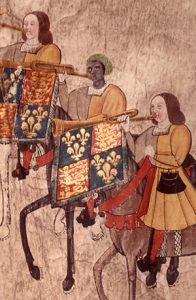
John Blanke served as a royal trumpeter at the courts of Henry VII and Henry VIII in the early 1500s; his image appears in the Westminster Tournament Roll. He petitioned Henry VIII successfully for a pay increase. His presence was recorded in royal accounts.
Later centuries saw Black sailors, servants, intellectuals and campaigners living and working in Britain. The presence was smaller than today, but it was real and documented.
Public office is not a religious test
Modern Britain has had Prime Ministers of Christian and Jewish heritage — including Benjamin Disraeli, born Jewish (though baptised Anglican) — and, more recently, a Prime Minister of Hindu faith in Rishi Sunak. The United Kingdom has also almost certainly had Prime Ministers who were agnostic or privately non-believing. What matters constitutionally is not creed, colour or culture, but competence and democratic mandate.
Catholics were barred from Parliament until 1829. Under the Tudors, Protestants and Catholics executed one another in the name of doctrinal purity.
Even within the past decade, Parliament has acted to remove residual confessional barriers from high office. The Succession to the Crown Act 2013 ended the automatic disqualification of anyone who married a Roman Catholic from succeeding to the throne, amending provisions that had stood since the seventeenth century — although the monarch themselves must still be in communion with the Church of England.
In 2023, Parliament moved swiftly and without controversy to pass the Lord High Commissioner (Church of Scotland) Act 2023 so that Lady Elish Angiolini, a practising Roman Catholic, could serve as the monarch’s representative to the General Assembly of the Church of Scotland — a role previously assumed to require adherence to that Church.
Both reforms were constitutionally modest but symbolically significant: they demonstrate that where historic sectarian exclusions linger in statute, modern Britain has shown itself willing to dismantle them in favour of equal civic participation.
“British values” were not born perfect. They were forged through struggle.
We have been here before
In the twentieth century, landlords displayed signs reading “No Blacks, No Irish, No Dogs.” Such discrimination was commonplace in the 1950s and 1960s. Few today would defend it. We recognise it as shameful.
After the Second World War, Britain strengthened its constitutional settlement with a renewed commitment to freedom of thought, conscience and religion.
Those freedoms did not appear overnight. They evolved through common law traditions and were strengthened over the centuries through statute.
The United Kingdom played a central role in drafting the European Convention on Human Rights in 1950. Sir David Maxwell Fyfe was one of its key architects. Article 9 protects freedom of thought, conscience and religion.
That commitment is not alien to British history. It is an outworking of it.
The myth of “reciprocity”
More troubling than the tinsel wars, however, is the recurring claim that “we shouldn’t allow Muslims to build mosques here until they let us build churches in their countries”.
Leaving aside the basic geographical error — British Muslims’ country is Britain — the argument is wrong.
First, it is factually wrong to claim that churches are universally banned in Muslim-majority countries. Churches operate openly in countries such as Egypt, Jordan and the United Arab Emirates — as well, of course, in the birthplace of Jesus himself, Bethlehem, one of 16 governorates administered by the Palestinian Authority in the West Bank — a reminder that the birthplace of Christianity itself lies in a Muslim-majority jurisdiction.
Restrictions do exist in some states; persecution exists in others. But British constitutional principle has never been built on reciprocal sectarianism.
If you genuinely believe in British values, you believe in freedom of religion, freedom of speech and freedom of assembly. You do not suspend those rights because another government fails to honour them.
If your commitment to British values depends on denying planning permission for a mosque because Saudi Arabia restricts church construction, then your commitment is not to liberty but to grievance politics.
And if you insist that a Muslim mayor marking Ramadan somehow negates Christmas — despite clear evidence that Christmas is celebrated, funded, promoted and publicly marked — then you are not defending heritage. You are manufacturing resentment.
London can illuminate Trafalgar Square for Christmas and light up the West End for Ramadan. It can host a menorah in December and celebrate Diwali in October. None of these extinguish the others.
The zero-sum framing is historically false and constitutionally illiterate.
What Britain actually stands for
The deeper question is what we think Britain stands for. A nation confident in its traditions does not feel threatened by its neighbours’ festivals. It does not require cultural vetoes. It does not reduce civic inclusion to sectarian arithmetic.
Proper British values — the ones painfully shaped over centuries — do not ask whether a citizen is Christian, Muslim, Jewish, Hindu, Sikh or atheist. They ask whether that citizen obeys the law and participates in the common good.
Christmas remains Christmas in London. Ramadan lights add to the city’s seasonal landscape. Chanukah candles burn in public squares. Diwali lanterns shine across neighbourhoods.
That is not erasure.
It is what a free, modern and historically self-aware Britain looks like.
Ramadan is expected to begin in the UK on the evening of 17 February, subject to moon sighting, and to conclude a month later with Eid al-Fitr. I wish Muslim readers a peaceful and blessed Ramadan: Ramadan Mubarak.