
RUN: how Gafcon keeps trying — and failing — to replace the Anglican Communion
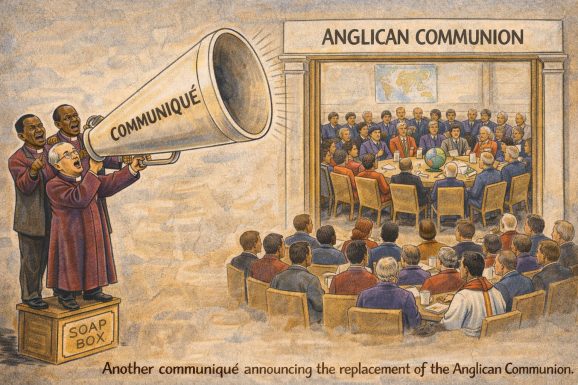
For nearly two decades, the Global Anglican Future Conference (Gafcon) has periodically announced new structures that supposedly replace or supersede the Anglican Communion. Yet the Communion continues to function — and even the provinces most closely aligned with Gafcon have never formally left.
If you don’t want to read the full 3,600 words, click here to read the 532 word tl;dr version
Every few years, the Global Anglican Future Conference — better known as Gafcon — announces something dramatic about the future of Anglicanism.
Sometimes the claim is that the Communion is being “reset.”
Sometimes that it must be “reordered.”
Sometimes that Canterbury is no longer relevant and that a new global Anglican structure has taken its place.
The latest announcement — dissolving Gafcon’s Primates’ Council and creating a new Global Anglican Council to lead what it now calls the “Global Anglican Communion” — follows the same familiar pattern.
The rhetoric is bold: a new structure, a new global body, a new future for Anglicanism.
Step back and look at the past 17 years and a pattern becomes clear.
None of this is new.
Since its launch in 2008, Gafcon has repeatedly announced structures that supposedly replace or supersede the Anglican Communion centred on Canterbury.
Yet every time, the same thing happens.
The Anglican Communion continues to exist.
Meanwhile, a small number of provinces have chosen to step away from the Communion’s shared structures — absenting themselves from the very conversations where the life of the Communion is shaped.
That absence has become a pattern.
And it is a pattern that can be summarised — rather neatly — in three letters.
A note on perspective and for transparency
Before going further, a note about transparency.
Much of what follows is based not only on public reporting but also on first-hand observation.
I first encountered Gafcon during the 2008 Lambeth Conference, when I was working as Director of Communications for the Bishop of Lichfield. During that conference I was given permission to operate the Lichfield News Service, reporting stories from around the Anglican world for newspapers in Staffordshire, Shropshire and the Black Country.
From 2011 onward, I worked as a freelance journalist covering Anglican Communion affairs, occasionally writing for the Anglican Communion News Service (ACNS).
In 2015, I became interim editor of ACNS, and later its editor.
From 2019 until 2023, I served as Director of Communications for the Anglican Communion, working closely with the Instruments of Communion and the Anglican Communion Office in London.
In other words, I spent more than a decade reporting on — and later working within — the Anglican Communion’s global structures.
That context matters for transparency.
But it also matters because it means I watched many of these developments unfold in real time, often from within the rooms where conversations were happening.
I no longer hold any role within the Anglican Communion structures, and what follows are my own views, based on both reporting and experience. Not being on the Anglican Communion’s payroll means I can now speak freely, without the professional caution required when representing an institution whose role is to hold together a deeply diverse global communion of Churches.
The recurring Gafcon pattern
To understand the present moment, it helps to revisit the timeline.
- 2008 – Jerusalem
Gafcon was launched at a conference in Jerusalem attended by several conservative Anglican leaders who believed the existing Communion structures had failed to uphold orthodox teaching. The conference produced the Jerusalem Statement and Declaration, which created the Fellowship of Confessing Anglicans and established a Primates’ Council to recognise Anglican jurisdictions and ministries.
From the beginning, this contained the seeds of a parallel structure. - 2009–2010 – Recognition of ACNA
Soon afterwards, Gafcon leaders recognised the newly formed Anglican Church in North America (ACNA), a body created by congregations and dioceses that had left the Episcopal Church and the Anglican Church of Canada.
The Anglican Communion itself did not recognise ACNA as a province.
But Gafcon did.
Already the movement was acting as a recognition mechanism parallel to Canterbury. - 2013 – Nairobi
At the second Gafcon gathering in Nairobi, leaders declared that Gafcon had become an “instrument of communion”, claiming the traditional Instruments — the Archbishop of Canterbury, the Lambeth Conference, the Anglican Consultative Council and the Primates’ Meeting — had failed. - 2018 – Jerusalem again
The third Gafcon conference announced plans for a more conciliar governance structure, including branches in provinces whose primates were not members of the Primates’ Council.
The conference also celebrated the launch of the Anglican Church in Brazil, recognised by Gafcon as a province even though the Anglican Communion did not recognise it. - 2020 – Europe
Gafcon’s Primates’ Council approved the creation of the Anglican Network in Europe, establishing alternative Anglican jurisdictions in England and continental Europe. - 2023 – Kigali
At Gafcon IV in Kigali, leaders issued the Kigali Commitment, declaring that they no longer recognised the Archbishop of Canterbury as an Instrument of Communion. - 2025 – “The future has arrived”
In another communiqué, Gafcon leaders declared that the Anglican Communion had effectively been reordered, rejecting the traditional Instruments of Communion and asserting that Gafcon now represented the authentic global Anglican body. - 2026 – Global Anglican Council
Now comes the latest step: dissolving the Primates’ Council and replacing it with a Global Anglican Council that includes bishops, clergy and lay representatives.
Once again the implication is clear: Gafcon is presenting itself as the structure that should lead global Anglicanism.
But there is a problem: the Anglican Communion still exists
Despite nearly two decades of such announcements, the Anglican Communion continues to function.
Its structures still operate:
- the Lambeth Conference
- the Anglican Consultative Council
- the Primates’ Meeting
- and the Archbishop of Canterbury
Those structures still serve the 42 autonomous provinces of the Anglican Communion.
And when those bodies meet, most provinces continue to attend.
The provinces that have RUN away
Three provinces consistently refuse to participate in those meetings in their capacity as provinces.
Their names form a rather revealing acronym.
RUN.
- Rwanda
- Uganda
- Nigeria
By choosing to step away from the Communion’s Instruments, they have also stepped away from the conversations where the Communion’s common life is discerned.
But running away from meetings is not the same thing as replacing the Anglican Communion.
The cost of RUNning away
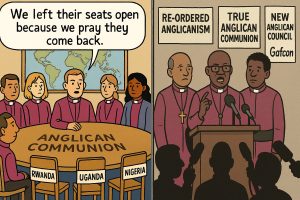
When Rwanda, Uganda and Nigeria refuse to attend meetings of the Instruments of Communion, something else happens as well.
They lose their voice.
At every Primates’ Meeting, their absence is noted. Their colleagues express regret that they are not present. Chairs are not removed and doors are not closed. Instead, space is deliberately left for them should they choose to return.
The Anglican Communion has consistently taken the position that disagreement — even very deep disagreement — is not a reason to exclude provinces from the life of the Communion.
But when provinces choose not to attend, they also choose not to participate in the conversations where the Communion’s shared life is shaped.
Their absence is not celebrated.
It is grieved.
The 2016 primates’ decision
One moment in particular illustrates how far reality diverges from some of the rhetoric about the Anglican Communion’s supposed collapse.
In January 2016, shortly after becoming Archbishop of Canterbury, Justin Welby convened a gathering of Anglican primates in Canterbury. Before the meeting he had travelled extensively across the Communion, visiting primates personally and listening to their concerns about the future of the Church in their provinces and about the future of the Anglican Communion itself.
At the meeting itself he posed a stark question.
Did the primates still wish to remain part of the Anglican Communion, or should they begin an orderly process of dismantling it?
The primates voted.
They unanimously chose to remain.
That decision — taken collectively by the leaders of the Anglican Communion’s provinces — remains one of the clearest expressions of the Communion’s continuing existence.
Whatever disagreements exist within the Communion, its leaders chose to continue walking together rather than begin dismantling the structures that hold the Communion together.
What exactly is Gafcon?
Part of the confusion lies in a simple question: What exactly is Gafcon?
The answer depends on who you ask.
In Western contexts — especially in North America and the UK — Gafcon rhetoric often presents the movement as a replacement Anglican Communion structure.
But in parts of Africa and Asia, the same movement is frequently described very differently: a renewal movement within the Anglican Communion.
Those two descriptions are not the same.
And the ambiguity produces misleading language, including the commonly used phrase “Gafcon primate”.
Primates belong to provinces.
A primate may support Gafcon.
But Gafcon itself is not a province, not a communion, and not a canonical structure recognised within Anglican polity.
Two very different models of authority
There is also a deeper structural difference between the Anglican Communion and the model of leadership that appears to be emerging within Gafcon.
The Anglican Communion is not a centralised church.
It is not structured like the Roman Catholic Church, where authority ultimately rests with the Pope. Nor is it a federation like the Lutheran World Federation.
Instead, it is a communion of autonomous and independent, yet interdependent, national and regional Churches.
Authority is therefore dispersed.
Provinces govern themselves through their own synods, bishops and canonical structures.
The Instruments of Communion do not exercise jurisdiction over provinces. They exist to facilitate consultation, discernment and common life, not to issue binding directives.
This is often misunderstood when critics speak about “removing the authority of the Archbishop of Canterbury”.
The reality is simpler.
The Archbishop of Canterbury does not possess authority over the Anglican Communion in the first place.
The role is one of convening, not governing.
The Archbishop invites bishops to the Lambeth Conference, convenes meetings of primates, and serves as president of the Anglican Consultative Council. But those bodies govern themselves.
At the Primates’ Meetings, for example, primates were invited in advance to submit agenda items. Staff at the Anglican Communion Office prepared a draft agenda from those submissions, and the first item of business at the meeting itself was agreeing that agenda collectively.
In other words, the agenda was not set by the Archbishop of Canterbury but collaboratively by the primates themselves.
During Archbishop Justin Welby’s time in office, he rarely chaired the sessions himself. Other primates were invited to lead particular discussions.
A similar pattern applies to the Anglican Consultative Council.
Although the Archbishop of Canterbury is its president, he does not preside over its meetings. The ACC elects a chair and vice-chair from among its own members, and they lead the sessions.
The agenda is developed by the Anglican Communion Office — a secretariat, not a head office — drawing on the work of authorised Anglican networks and commissions, submissions from provinces, and the work of the ACC Standing Committee, which is elected by the council itself.
Even the Lambeth Conference reflects this dispersed approach.
The Archbishop of Canterbury issues the invitations to bishops of the Communion, but the programme is developed by an international working group drawn from across the Anglican Communion and representing a wide range of theological traditions.
The Primates’ Standing Committee — primates elected regionally by their colleagues — plays a role in consulting with provinces and shaping the programme.
In other words, authority in the Anglican Communion flows outwards and across, rather than downwards from a central authority.
That model stands in sharp contrast to a structure in which a central body makes pronouncements about what provinces should believe, say or do.
The loudest voices are not in the Anglican Communion
Another curious feature of the Gafcon project is where some of its most influential voices come from.
Many of the strongest advocates for dismantling the Anglican Communion’s existing structures are leaders of the Anglican Church in North America (ACNA).
ACNA was formed in 2009 by congregations and dioceses that left the Episcopal Church and the Anglican Church of Canada.
It has never been recognised as a province of the Anglican Communion.
Nor has it sought membership through the Communion’s normal processes.
Yet ACNA figures prominently within Gafcon leadership and strategy.
Which creates an unusual situation.
Some of the loudest voices advocating the dismantling of the Anglican Communion are coming from a church that is not itself part of the Anglican Communion.
A proliferation of bishops
Another feature of Gafcon-aligned structures in Europe raises questions about scale and representation.
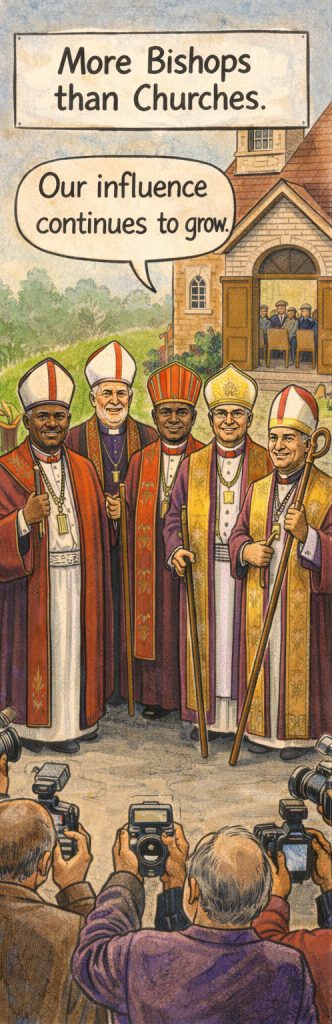
The Anglican Mission in England, part of the Anglican Network in Europe, has repeatedly announced the consecration or appointment of new bishops.
Yet observers have noted the contrast between the number of bishops being appointed and the relatively small number of congregations involved.
At times it can appear that there are more bishops than local churches.
The elevation of additional bishops inevitably gives leaders greater visibility and standing in public debates about Anglicanism.
But it also raises a question.
Whether these appointments reflect the scale of the mission on the ground — or whether they function primarily to create the appearance of a larger ecclesial structure than actually exists.
Gafcon is not even united
Another reality often overlooked in public commentary is that Gafcon itself is not a united body.
Even on the central issue that has driven many of its disputes — human sexuality — there have been tensions among its leading provinces.
One example emerged in 2021 when extremely strong language used by the Primate of Nigeria exposed tensions between the Nigerian Church and ACNA leaders, who operate in a very different political and legal environment in the United States.
The disagreement illustrated a wider truth.
The coalition that makes up Gafcon is far from unified, and internal tensions frequently surface once rhetoric meets reality.
A question of moral authority
The credibility of some of Gafcon’s most vocal critics of the Anglican Communion has also been undermined by events closer to home.
Former Archbishop of Uganda Stanley Ntagali was among the loudest voices condemning what he described as the moral failings of Western provinces of the Communion.
Yet in 2020, after leaving office, Ntagali admitted to a long-running extramarital affair with the wife of a priest.
His successor suspended him from exercising episcopal ministry, and the Church of Uganda imposed disciplinary restrictions on his public ministry.
For many observers, the episode highlighted an uncomfortable contrast between public denunciations of other provinces and personal conduct.
It was also a reminder that the moral and spiritual challenges facing the Anglican Communion are not confined to any one region of the world.
Attempts to influence Communion meetings
Over the years, ACNA-linked activists have also attempted to influence or undermine the official meetings of the Anglican Communion’s Instruments.
During the 2017 Primates’ Meeting in Canterbury, US-based Gafcon figures who were not participants in the meeting booked into a nearby hotel and organised their own media briefings.
At one such briefing, journalists were told that Gafcon-aligned primates were furious because the Presiding Bishop of the Episcopal Church, Michael Curry, had led prayers at the opening evensong in Canterbury Cathedral.
The reality was very different.
Curry had been invited to lead a specific moment of prayer following the Route 91 Harvest festival shooting in Las Vegas, which had left 60 people dead and more than 400 injured.
The primates agreed that his prayer should be recorded and shared with people in the United States so that he could speak into a national tragedy while he was overseas.
Far from expressing outrage, several conservative primates embraced him, prayed with him and supported him.
Journalists later spoke directly with primates during informal conversations inside the cathedral precincts, and their responses were overwhelmingly positive.
Yet the narrative presented at the Gafcon briefing suggested the meeting was on the brink of collapse.
When spokespeople speak for others
Recent reporting illustrates another recurring pattern.
Some media reports have suggested that Gafcon has “rowed back” from earlier suggestions that it might elect a replacement global Anglican leader to take the place of the Archbishop of Canterbury.
The contrast between earlier rhetoric and current messaging is striking.
In interviews and briefings, US-based spokespeople have often spoken confidently about what provinces in Africa and Asia would do next.
Yet when the moment for such decisions arrives, those provinces frequently take a more cautious or pragmatic approach.
Recent BBC reporting on Gafcon’s latest announcement illustrates the gap between the rhetoric of US-based spokespeople and the actual positions taken by provincial leaders.
It also illustrates another curious feature of the narrative surrounding the Anglican Communion.
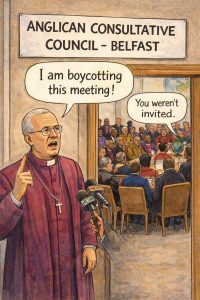
Some reports have suggested that Gafcon will boycott the upcoming meeting of the Anglican Consultative Council in Belfast. But participation in the ACC is determined by the provinces themselves.
And those provinces remain members of the council.
One prominent voice in such statements has been the Rt Revd Paul Donison, the General Secretary of Gafcon.
Yet Donison himself is not part of the Anglican Communion.
He belongs to the Anglican Church in North America, which — despite close relationships with some provinces — is not recognised as a province of the Anglican Communion.
Statements suggesting that Gafcon will boycott the ACC meeting in Belfast therefore have an obvious limitation.
The person making the statement is not himself invited to attend such meetings.
Nor is the church to which he belongs.
The same pattern in Jordan and Lambeth
Similar attempts occurred elsewhere.
During the January 2020 Primates’ Meeting in Jordan, a couple of ACNA/Gafcon-linked individuals booked rooms in the same hotel where the meeting was being held, apparently hoping to put pressure on Gafcon-aligned primates.
And during the 2022 Lambeth Conference, Gafcon organised alternative media briefings in Canterbury where US-based activists presented interpretations of events that were contradicted by bishops and primates attending the conference itself.
At one stage Archbishop Justin Badi Arama of South Sudan, presented publicly as a key Gafcon spokesperson during the Lambeth Conference, later denied saying some of the things attributed to him in Gafcon communications.
Neo-colonial dynamics
These incidents reveal something uncomfortable.
Much of the messaging around Gafcon is driven by well-funded conservative networks in the United States and Britain, which sometimes appear to speak for African and Asian bishops without asking them what they themselves wish to say.
Many observers have described this dynamic as a form of neo-colonialism.
Wealthy Western activists present themselves as defenders of the Global South while simultaneously shaping the narrative on its behalf.
The Badi example
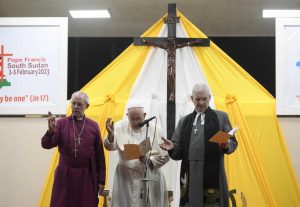
The experience of Archbishop Justin Badi Arama illustrates this tension.
During the Lambeth Conference he was widely portrayed as the public voice of conservative resistance.
Yet only months later he welcomed Archbishop of Canterbury Justin Welby, Pope Francis and the Moderator of the Church of Scotland to South Sudan for an unprecedented joint ecumenical peace pilgrimage to South Sudan.
It was the only time leaders of those three Christian traditions had undertaken such a joint visit.
Recognition claims that do not match reality
Gafcon communications frequently suggest that a majority of Anglican provinces recognise ACNA as a member of the Anglican Communion.
This is not correct.
Several provinces have clarified Gafcon statements to make clear that their recognition of ACNA is limited to acknowledging it as a Christian Church or recognising its orders.
That is very different from recognising it as a province of the Anglican Communion.
Recognition of ministry is not the same thing as membership of a communion.
The constitutional question
There is also a deeper constitutional point.
The Anglican Consultative Council (ACC) is the only Instrument of Communion established by a formal constitution.
If provinces such as Rwanda, Uganda and Nigeria truly believe that the Anglican Communion no longer exists, a simple question follows.
Why have they not withdrawn from the ACC?
They could give notice that they wish to cease membership. Yet none has done so. They remain listed members.
The silence of provincial synods
Despite nearly two decades of declarations and communiqués, there is still no documented evidence that any provincial synod has formally voted to leave the Anglican Communion.
Not one.
The rhetoric may speak of a new communion.
But the constitutional reality remains unchanged.
When primates do not speak for their provinces
Examples from within Gafcon-aligned provinces themselves also suggest that primatial rhetoric does not always reflect the position of the province as a whole.
In the Province of the Indian Ocean, former primate Archbishop James Wong was widely associated with statements suggesting that the province had distanced itself from Canterbury.
Wong later retired, and his successor, Archbishop Gilbert Rakotondravelo, adopted a noticeably different approach to relations within the Anglican Communion.
Events in Madagascar illustrated the shift.
A Malagasy diocese that had a longstanding companion link with the Diocese of London had wished to invite the Bishop of London Sarah Mullally to attend the consecration and installation of its new bishop. That invitation was blocked by Archbishop Wong.
After the change of primate, however, the new bishop in Madagascar promptly invited the Bishop of London to visit.
The episode demonstrated something important.
Statements by primates about distancing themselves from Canterbury often do not reflect the views of the entire province.
The reality behind the rhetoric
For nearly two decades, Gafcon has repeatedly announced new structures intended to replace the Anglican Communion.
Yet the Communion continues to function.
Its Instruments still meet.
Its provinces remain members.
And even the provinces that have chosen to RUN away from the table have not taken the constitutional steps required to leave it.
Which leads to a rather unavoidable conclusion. Yet another reality is easy to overlook amid the rhetoric.
If the Anglican Communion had truly been replaced, its structures would not still be functioning, its provinces would not still be participating, and its councils would not still be meeting.
Yet the Lambeth Conference still gathers bishops from across the world.
The Primates’ Meeting still convenes leaders of provinces.
The Anglican Consultative Council still meets with bishops, clergy and lay representatives from across the Communion.
The life of the Communion continues — not because of declarations or communiqués, but because the Churches themselves continue to participate in it.
And until any province actually follows the constitutional process required to leave the Anglican Consultative Council — and therefore the Anglican Communion itself — the repeated announcements of a replacement communion will remain what they have been since 2008:
Not a reality — just another communiqué.
Tl;dr — RUN away: the short version
For nearly two decades, the Global Anglican Future Conference (Gafcon) has repeatedly announced new structures that supposedly replace or supersede the Anglican Communion. Yet the Anglican Communion continues to function — and even the provinces most closely aligned with Gafcon have never formally left it.
Since its launch in 2008, Gafcon has periodically declared that the Anglican Communion centred on Canterbury has failed and must be replaced. Over the years this has taken various forms: recognising alternative Anglican jurisdictions, creating parallel networks, declaring the Archbishop of Canterbury no longer an Instrument of Communion, and most recently establishing a “Global Anglican Council”.
But the underlying claim remains the same: that Gafcon represents the “real” Anglican Communion.
The problem with that claim is simple. The Anglican Communion still exists and continues to operate through its existing Instruments: the Lambeth Conference, the Primates’ Meeting, the Anglican Consultative Council and the Archbishop of Canterbury.
Most of the Communion’s 42 autonomous Churches continue to participate in those structures.
Three provinces — Rwanda, Uganda and Nigeria — have largely chosen not to participate in meetings of those Instruments as provinces. Together their names form a neat acronym: RUN.
By stepping away from the Communion’s shared structures, those provinces have effectively RUN away from the table where the Communion’s common life is discussed and shaped. Their absence is regularly noted and regretted by other primates, and seats remain open for them should they wish to return.
But running away from meetings is not the same as leaving the Anglican Communion.
In fact, there is no documented evidence that any provincial synod has formally voted to leave the Anglican Communion. Nor have those provinces withdrawn from the Anglican Consultative Council, which is the Communion’s only body established by a formal constitution. Their Churches remain listed as members.
If they truly believed the Anglican Communion no longer existed, they could formally withdraw from the ACC. They have not done so.
Another misunderstanding concerns authority. The Anglican Communion is not a centralised Church with a governing hierarchy. It is a communion of autonomous and independent yet interdependent Churches. The Archbishop of Canterbury does not exercise jurisdiction over the Communion; the role is primarily one of convening and facilitating.
Gafcon, by contrast, increasingly operates through central statements and communiqués claiming to speak for large parts of the Communion — even though many of the loudest voices within Gafcon come from the Anglican Church in North America (ACNA), which is not itself part of the Anglican Communion.
There have also been moments where outside activists linked to ACNA have attempted to influence Communion meetings or speak on behalf of bishops and provinces who later expressed more nuanced positions.
None of this means disagreements within the Anglican Communion are trivial. They are real and often serious. But disagreement does not equal dissolution.
The Anglican Communion continues to meet, deliberate and worship together because its member Churches continue to participate in its shared life.
And until any province actually follows the constitutional process required to withdraw from the Anglican Consultative Council — and therefore from the Anglican Communion itself — the repeated announcements that the Communion has been replaced remain what they have been since 2008:
Not a reality — just another communiqué.

Gavin. I appreciated the abbreviated version! You are so well placed to speak with authority on this matter. And what you say makes sense.
Strange how I needed to be reminded that ACNA is not part of the Anglican Communion!