Westminster’s permanent panic
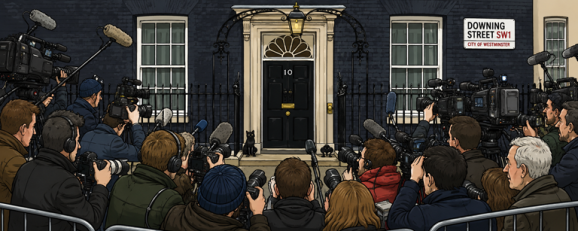
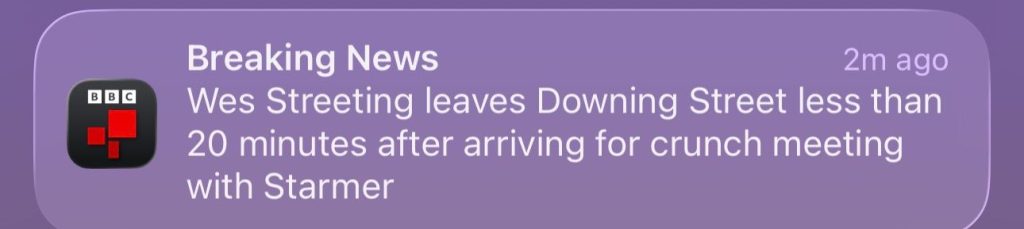
A BBC News app alert this morning told me that Wes Streeting has left Downing Street less than 20 minutes after arriving for “crunch meeting with Starmer”. Sky news’s presenter Sophie Ridge said she “cannot believe” that a meeting between Streeting and Starmer “lasted just 16 minutes”. The front pages of every national newspaper is reporting a leadership crisis.
Yesterday’s rolling news coverage across all broadcasting channels — television and radio — was clearly anticipating a political decapitation of the Labour party in the style of Boris Johnson’s departure from the Conservative party.
But, as it stands, Keir Starmer is still Prime Minister and leader of the Labour party and, in a few short hours, the King will deliver his speech at the State Opening of Parliament setting out the government’s priorities for the coming session of Parliament.
Unlike Boris Johnson, the pressure on Keir Starmer is not based on criminal wrongdoing, but on his charisma, or perceived lack of it. I don’t blame the media for the wall-to-wall coverage. They are responding to what is unfolding. At its core was the call at the weekend by Hornsey & Friern Barnet MP Catherine West who called for the Cabinet to reshuffle itself and select a new Prime Minister.
Speaking to Radio 4, she said: “My preferred option is for the cabinet to do a reshuffle within itself, where there’s plenty of talent, and for Keir to be given a different role, which he might enjoy, perhaps an international role, then for others to come to the fore who can communicate the message, who are very able, so we can have minimum fuss.”
Ignoring the fact that the Labour party will have rules which set out how its leaders are chosen, and that the Cabinet is not in a position to anoint a new leader, the call for a leader who can “communicate the message” misses the point.
Boris Johnson was a consummate communicator. Being somebody who could communicate the message didn’t help him, and it didn’t help the Conservative party. And any communicator — whether working in the political sphere or in any other areas, such as commerce, public services, charities and corporations — will be aware of Harold Macmillan’s famous rebuttal: “Events, dear boy, events.”
Even the best-crafted and best-resourced communications strategy can be derailed by events beyond the communicator’s control. Looking back over the past week, you could argue that the event was the local elections and the disastrous results for Labour. But you would be wrong.
The local elections were timetabled years in advance and the polls pointed to the likely result. If anything, Labour performed slightly better than some predictions. The Labour party machinery and Keir Starmer’s communications staff would have had a strategy to deal with that. The real “event” that derailed that strategy was Catherine West’s public threat to spark a leadership challenge – a threat that she did not deliver on.
I’m not privy to the Prime Minister’s communications strategy. But it almost certainly would have included activity around today’s King’s Speech — the setting out of the Government’s objectives for the coming year. But the media aren’t talking about that. They aren’t talking about Labour’s successes in the last Parliamentary session. They are talking exclusively about a Prime Minister “clinging on to power”.
But the country has not been asked directly to pass judgment on the national government. These were local elections, even if their results inevitably carry implications for Westminster politics.
Yes, there are angles about what the votes, vote shares, percentages and swings mean for national politics, but where is the attention to local results and the parties that have done well in them.
I said “local” elections, but there were, of course, national elections to the Scottish Parliament and Senedd Cymry. For the first time, the three devolved national legislatures are led by separatist parties. Where is the wall-to-wall coverage about what this means for the union of Great Britain and Northern Ireland?
And, of course, the party that performed well was Reform UK. Where is the wall-to-wall coverage examining Nigel Farage’s refusal to provide further details about the £5 million he described as “personal gift”? In questions put to Reform representatives before and after last week’s elections, the answer was inevitably along the lines that “Nigel has answered that” or “that is for Nigel to answer”. Yet when questions are put to Farage, his response — always terse and with threats to walk away from the interview — was that he had no intention of answering questions about what he insisted was “a personal gift”.
This is the man that many media outlets tell us will be the next Prime Minister. Why isn’t there any wall-to-wall coverage of this? Where is the calling to account?
Since the election, there have been reports on social media that some of the newly-elected Reform councillors have been suspended and / or removed from the Reform UK party because of racist and anti-Semitic social media posts. Others have stood down because they did not intend to be elected. And one, reportedly, was confused that, having won a local election, he wasn’t an MP.
Where is the attention to these allegations?
One reason for the lack of scrutiny is because of the wall-to-wall coverage of internal navel-gazing by Labour MPs.
There is widespread speculation that Andy Burnham will be the next Prime Minister and there is criticism of Labour’s National Executive Committee’s (NEC) decision to block Burnham standing for Labour in the Gorton and Denton by-election. The commentary about this is focused on the suggestion that he was blocked to stop him being a challenger to Keir Starmer.
There are other good reasons to have blocked the nomination. Burnham asked to be Labour’s candidate to be executive Mayor of Greater Manchester. He was selected and won the election. Such a person — of whatever party and wherever the mayoralty — would generate accusations that they lack commitment. He was elected to serve as mayor for a fixed term and he should serve that term.
There are even stronger arguments against the suggestion that an MP in a safe Labour seat should resign so that he could stand in a by-election. Firstly, it tells the residents of that constituency that Labour takes their votes for granted. No MP should assume that they are guaranteed to win. That is true at any time, but is particularly true in this era where the age of two dominant political parties is at an end.
In that scenario, it is entirely plausible that Burnham would not be elected as MP of the constituency; and that Labour would lose the subsequent by-election for Mayor of Manchester. In that scenario, the pressure on whoever was leading the Labour party to call a general election would be immense.
Keir Starmer has made mistakes; and some of those have been damaging. Show me a Prime Minister, of whatever party, who hasn’t?
His critics portray him as managerial rather than inspirational. But competence and communication are not the same thing, and charisma alone is no guarantee of effective government.
The electorate seem to want a new government to deliver immediate change. Change doesn’t happen like that and our political system recognises this, with five-year terms for Parliaments rather than annual elections. Change is happening. We need to be patient for the results of that change to emerge.